Hazardous Material Escort Robot








Client Background
The subdistrict jurisdiction covers a large area with a high proportion of elderly residents. Grassroots government service outlets have limited distribution, and elderly groups generally have low acceptance of intelligent devices.
Core Challenges
Insufficient Outlet Coverage
Inconvenient for Elderly Residents
Prominent Digital Divide
Difficult High-Frequency Service Processing
Insufficient Outlet Coverage
Specific Pain Points

Grassroots government service outlets are limited in number; residents must travel long distances to process government services, making nearby service access difficult to achieve.
RACETEC Solution

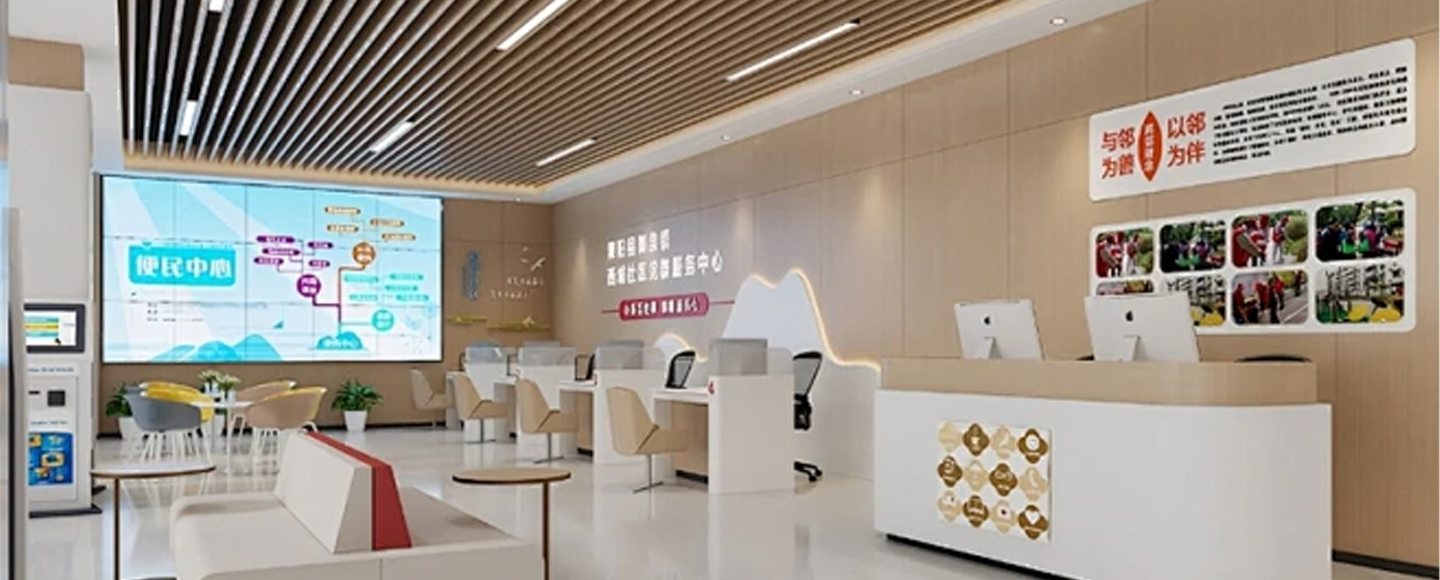
Government all-in-one terminals are deployed in community outlets, enabling self-service processing of high-frequency services nearby. Supporting the subdistrict in building a "15-Minute Government Service Circle," the vast majority of community high-frequency services can be completed within the community.
Inconvenient for Elderly Residents
Specific Pain Points
Elderly residents have declining vision and limited operation skills, making it difficult to complete service processes independently on standard interfaces.
RACETEC Solution
With one-tap switching to the elderly-friendly large-font mode, the interface has larger fonts and simpler workflows — elderly residents can complete operations independently without assistance.
Prominent Digital Divide
Specific Pain Points
Elderly groups have anxiety about using smart devices, and residents with limited Mandarin proficiency struggle to complete interactions through conventional methods.
RACETEC Solution
With dialect voice guidance capabilities, residents can interact with devices in familiar dialects — lowering the barrier to using smart devices and ensuring digital government services reach elderly populations.
Difficult High-Frequency Service Processing
Specific Pain Points
Community high-frequency service processes are complex; residents often get stuck processing them alone, resulting in higher service costs.
RACETEC Solution
With shoulder-to-shoulder collaborative processing capabilities, grid workers and residents operate on the same screen with synchronized guidance — forming a human-machine collaborative service model that effectively bridges the "last mile" of grassroots government services.

Value Delivered
One-Time Material Submission, Multi-Terminal Sharing
Previously, citizens applying for one service had to visit multiple windows and repeatedly fill out the same materials, with no data sharing between windows. Now, based on the HarmonyOS Distributed Soft Bus, materials uploaded once are synchronized across devices; citizens submit at one window and other windows automatically retrieve them — transforming from "multiple trips, repeated filling" to "one submission, end-to-end sharing."
Counter Communication, Desk-Side Collaboration
Previously, services relied on verbal descriptions through glass; citizens couldn't explain clearly, staff couldn't hear fully, and material issues bounced back and forth. Now, with real-time screen sharing on domestic terminals, both parties view and operate the same screen, with two-way annotation and voice interaction — transforming from "shouting through glass" to "face-to-face collaboration."
Form Filling, First-Time Pass
Previously, manual form filling was time-consuming and laborious; one mistake meant starting over, requiring citizens to queue repeatedly and make multiple trips. Now, AI automatically pre-fills key fields, verifies format and logic in real time, and recognizes multi-modal input such as handwriting and voice — transforming from "filled then rejected, rejected then revised" to "filled correctly the first time, approved on the first try."
Grassroots Services, Right at Your Doorstep
Previously, government services were concentrated in halls; residents in communities and remote areas had to travel long distances and queue for hours, and areas with unstable networks simply couldn't process applications. Now, lightweight terminals are deployed to communities and subdistricts, with offline processing available and automatic sync upon reconnection — transforming from "travel far, rely on luck" to "services right at your doorstep."