Hazardous Material Escort Robot










Client Background
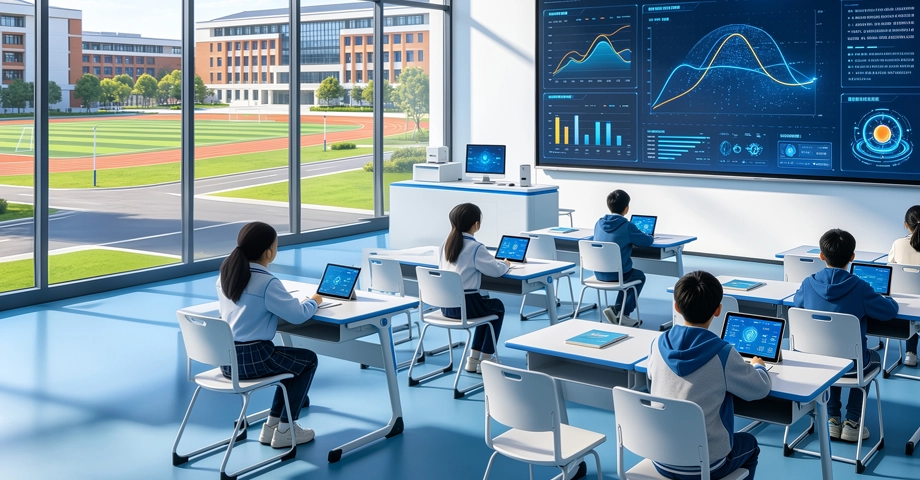
A provincial demonstration high school education group with 3 campuses, over 120 classrooms, and more than 8,000 students and teachers. At the 2024 Global Smart Education Conference, the Ministry of Education clearly advanced the Education New Infrastructure and Informatization 2.0 Action Plan. As a regional education Xinchuang pilot unit, the school urgently needs to build a smart campus solution based on an autonomous and controllable technology foundation, replacing the traditional multimedia teaching systems characterized by fragmented brands and data silos.
Core Challenges
Fragmented Teaching Interaction Experience
Delayed Campus Safety Response
High Equipment O&M Burden and Energy Consumption
Data Silos and Closed Ecosystem
Fragmented Teaching Interaction Experience
Specific Pain Points

Multimedia devices operate independently with cumbersome operations; teacher-student interaction is limited to raising hands and Q&A, unable to capture student engagement; "one-size-fits-all" teaching content cannot be dynamically adjusted to individual differences.
RACETEC Solution

HarmonyOS Super Device · Multi-Device Collaborative Teaching
Leveraging the HarmonyOS Distributed Soft Bus, devices such as the podium host, student tablets, electronic whiteboards, and speakers achieve one-tap connection and seamless flow. Teachers can freely drag teaching materials to any screen; combined with multi-modal perception for real-time analysis of classroom atmosphere and student engagement, AI agents instantly generate learning reports — driving "individualized for each student" adaptive precision teaching.
Delayed Campus Safety Response
Specific Pain Points
Security relies on manual monitoring review or post-incident tracing, with abnormal behaviors unable to be warned in real time; attendance relies on roll call or card swiping, allowing proxy check-ins; fire protection, access control, and other systems operate independently, unable to coordinate evacuation in emergencies.
RACETEC Solution
On-Device AI Behavior Recognition · Multi-Layered Security ProtectionOn-device AI algorithms are deployed to achieve millisecond-level recognition and automatic alarming for behaviors such as fighting, falls, crowding, and intrusion into dangerous areas. Combined with facial recognition, frictionless entry-exit attendance and campus activity trajectory visualization are achieved. In emergencies, the system automatically links door access opening, broadcast guidance, and lighting indication — building a multi-layered security protection network.
High Equipment O&M Burden and Energy Consumption
Specific Pain Points
Devices have mixed brands and numerous protocols, making fault diagnosis difficult with high manual inspection costs; classroom lights and air conditioners left on cause severe energy waste; a unified management platform is lacking, preventing remote batch upgrades and control.
RACETEC Solution
Unified Device Management · Scenario-Based Green Energy Saving
Based on HarmonyOS unified access standards, heterogeneous devices achieve unified visibility, management, and control, with automatic fault reporting and self-healing attempts. Through light and occupancy sensor linkage, "lights on when people arrive, off when they leave" and smart air-conditioning temperature adjustment are realized — supporting remote batch power on/off and software upgrades for campus-wide devices.
Data Silos and Closed Ecosystem
Specific Pain Points
Teaching, management, and security data are scattered across different systems, unable to be integrated and analyzed to support decision-making; the ecosystem is closed, with slow new application development and adaptation, unable to meet rapid innovation demands.
RACETEC Solution
Full-Chain Data Closed Loop · Open Source Ecosystem
Data across the entire teaching, learning, management, and evaluation chain is connected to build an education big data center, providing managers with scientific decision-making basis. Based on the OpenHarmony foundation, rich APIs and development tools are provided to attract developers to co-build the education application ecosystem and rapidly respond to scenario innovation demands.

Value Delivered
Classroom Teaching, from One-Way Lecturing to Multi-Dimensional Interaction
Teaching devices such as the podium host, student tablets, electronic whiteboards, and speakers achieve one-tap interconnection and cross-screen content flow — teachers can flexibly schedule any terminal to present teaching content. The system real-time collects classroom learning data and automatically generates analysis reports, matching differentiated learning resources for each student — teaching evolves from "unified pace" to "individualized instruction."
Campus Safety, from Manual Inspection to Intelligent Perception
Abnormal behaviors such as fighting, falls, crowding, and intrusion into dangerous areas are automatically recognized by AI with instant alarms — no longer relying on security personnel to patrol surveillance screens one by one. Students' campus entry and exit achieve frictionless attendance, with campus activity trajectories fully visible. Fire protection, access control, broadcast, and other security subsystems automatically link in emergency states, forming an integrated emergency response chain.
Equipment O&M, from Room-by-Room Inspection to Centralized Unified Management
Heterogeneous devices in over a hundred classrooms — projectors, whiteboards, lighting, air conditioners, and more — are all connected to a unified management platform, with real-time visibility of operating status, automatic fault reporting, and self-healing attempts. Lighting and air conditioning are intelligently adjusted based on ambient light and occupancy density; campus-wide devices support remote batch power control and system upgrades — O&M no longer relies on manual room-by-room inspection.
Campus Data, from Fragmented Scatter to Integration-Driven
Teaching, management, and security data are no longer placed in separate independent systems; all are aggregated into a unified education data platform, providing a global perspective for academic decision-making. Based on the APIs and development tools opened by the OpenHarmony foundation, third-party education applications can be rapidly integrated — campus digitalization capabilities continuously expand with scenario demands.